A Beginner’s Guide To Sustainable farming
Agronomy is a branch of agricultural science that focuses on crop production, soil management, and sustainable farming practices. It is the science of growing crops efficiently while maintaining soil health, conserving natural resources, and improving agricultural productivity. Agronomy combines knowledge from soil science, plant science, environmental science, and crop management to help farmers produce food, feed, fiber, and fuel sustainably.
As the global population continues to grow, the importance of agronomy has become greater than ever. Agronomists work to develop farming practices that increase crop yields, improve soil fertility, enhance water-use efficiency, and support sustainable agriculture. From selecting the right crop varieties to managing nutrients and controlling pests, agronomy plays a vital role in ensuring food security and environmental sustainability.
Whether you are a farmer, student, researcher, or agriculture enthusiast, understanding what agronomy is can help you appreciate the science behind successful crop production and modern farming systems.

Why Is Agronomy Important?
Agronomy plays a crucial role in feeding the world’s growing population. The Food and Agriculture Organization (FAO) emphasizes that sustainable crop production is essential for global food security and environmental conservation. As demand for food increases, farmers must produce more crops using limited land and resources.
Agronomic practices help achieve this by:
- Improving crop yields.
- Maintaining soil fertility.
- Conserving water resources.
- Reducing environmental impacts.
- Managing pests, diseases, and weeds.
- Enhancing food security.
Without agronomy, modern agriculture would struggle to meet the nutritional needs of billions of people (FAO, 2024).
What Does an Agronomist Do?
An agronomist is a professional who applies scientific principles to crop production and soil management. According to the International Maize and Wheat Improvement Center (CIMMYT), agronomists bridge the gap between agricultural research and practical farming by helping farmers adopt improved technologies and management practices.
Their responsibilities may include:
- Recommending suitable crops for specific regions.
- Testing and improving soil health.
- Developing fertilizer recommendations.
- Advising farmers on irrigation practices.
- Managing weeds, pests, and diseases.
- Evaluating new crop varieties.
- Promoting sustainable farming methods.
Agronomists work with farmers, research institutions, governments, agribusiness companies, and development organizations.
Main Areas of Agronomy
1. Soil Science
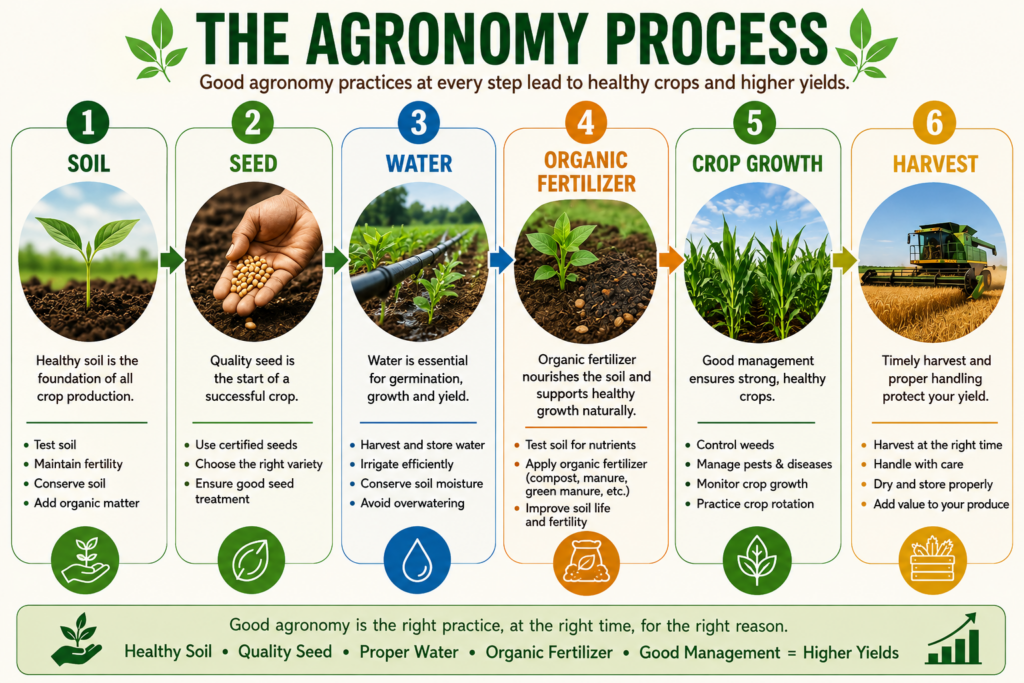
Healthy soil is the foundation of successful crop production. Soil science focuses on understanding soil properties, fertility, structure, and biological activity. The FAO notes that healthy soils support plant growth, store water, recycle nutrients, and sustain biodiversity (FAO, 2024).
Key topics include:
- Soil fertility
- Soil pH
- Organic matter
- Nutrient management
- Soil conservation
2. Crop Production
Crop production involves selecting suitable crops and implementing management practices that maximize growth and yield. Agronomic research helps determine the best planting dates, crop varieties, and management practices for specific environments (CIMMYT, 2024).
Examples include:
- Planting dates
- Plant population
- Crop rotation
- Variety selection
- Harvest management
3. Weed Management
Weeds compete with crops for water, nutrients, sunlight, and space. Studies from the International Institute of Tropical Agriculture (IITA) show that effective weed management can significantly increase crop yields and reduce production losses, particularly in smallholder farming systems.
Agronomists use a combination of:
- Cultural practices
- Mechanical control
- Biological control
- Herbicide application
4. Pest and Disease Management
Crop losses caused by insects, fungi, bacteria, and viruses can significantly reduce productivity. Agronomists promote integrated pest management strategies that combine biological, cultural, and chemical approaches to minimize damage while reducing environmental risks (FAO, 2024).
5. Water Management
Water is one of the most important resources in agriculture. Agronomists help farmers use water efficiently through irrigation scheduling, moisture conservation techniques, and improved water management systems. According to FAO (2024), efficient water use is becoming increasingly important as climate change affects rainfall patterns across many agricultural regions.
Agronomy and Sustainable Agriculture
Agronomy is closely linked to sustainable agriculture. Sustainable farming seeks to meet current food demands without compromising the ability of future generations to produce food. The FAO identifies sustainable crop production as a key strategy for balancing productivity, environmental protection, and economic viability (FAO, 2024).
Examples of sustainable agronomic practices include:
- Conservation agriculture
- Cover cropping
- Crop rotation
- Integrated nutrient management
- Precision agriculture
- Soil conservation techniques
These practices improve productivity while protecting ecosystems and natural resources.
Agronomy in Zambia
Agronomy is particularly important in Zambia, where agriculture contributes significantly to employment, rural livelihoods, and national food security. Agronomic research supports the production of major crops such as maize, soybeans, groundnuts, common beans, sunflower, wheat, and cassava. Improved agronomic practices have been shown to increase productivity and resilience among smallholder farmers throughout Sub-Saharan Africa (CIMMYT, 2024).
By adopting sound agronomic practices, Zambian farmers can increase yields, improve soil health, and better adapt to climate variability.
Career Opportunities in Agronomy
Agronomy offers diverse career opportunities in both the public and private sectors. Graduates may work as:
- Agronomists
- Crop consultants
- Soil scientists
- Agricultural researchers
- Extension officers
- Seed specialists
- Fertilizer specialists
- Precision agriculture specialists
As global demand for food continues to rise, the need for trained agronomists is expected to grow (American Society of Agronomy, 2024).
Conclusion
Agronomy is the science and practice of growing crops while managing soil, water, and other resources sustainably. It serves as the foundation of modern agriculture by helping farmers improve productivity, maintain soil health, and strengthen food security. Through scientific research and practical field applications, agronomy contributes to sustainable farming systems capable of feeding a growing global population while protecting the environment.
References
American Society of Agronomy (2024). What is Agronomy? Available at: American Society of Agronomy (Accessed: 1 June 2026).
Food and Agriculture Organization (FAO) (2024). Sustainable Crop Production and Soil Management. Available at: Food and Agriculture Organization (FAO) (Accessed: 1 June 2026).
International Maize and Wheat Improvement Center (CIMMYT) (2024). Agronomy and Sustainable Intensification. Available at: CIMMYT (Accessed: 1 June 2026).
International Institute of Tropical Agriculture (IITA) (2024). Crop Production and Sustainable Farming Systems. Available at: International Institute of Tropical Agriculture (IITA) (Accessed: 1 June 2026).